How do you use AI to develop quality research software?
This section of RSQKit is focussed on guidance and practices using AI to creating high quality research software. When considering where to start - always start from the work, not the tool or practice.
Most pages include multiple different approaches for improving quality. If you do not have the time to apply all of them, practicality beats purity - focus on the key aspects:
- Research correctness of output
- Guardrails
- Ability to rollback
- Reproducibility
Guidance
Guidance pages focus on overview, high level, and cross cutting concerns.
Practices
Practice pages focus on specific guidance for a given style of usage, ordered by intensity level. Each practice has guidance on the following topics
- Overview - what is the practice, when is it useful?
- Getting Started - how to get started
- Sample/Example Appropriate Practice - example scenarios
- Concerns/Risks - What risks are related to this practice?
- Quality Practice - What quality practices can you apply to this practice to help/assist with research software quality at this level
- AI Intensity Considerations - Why might you consider using more or less AI?
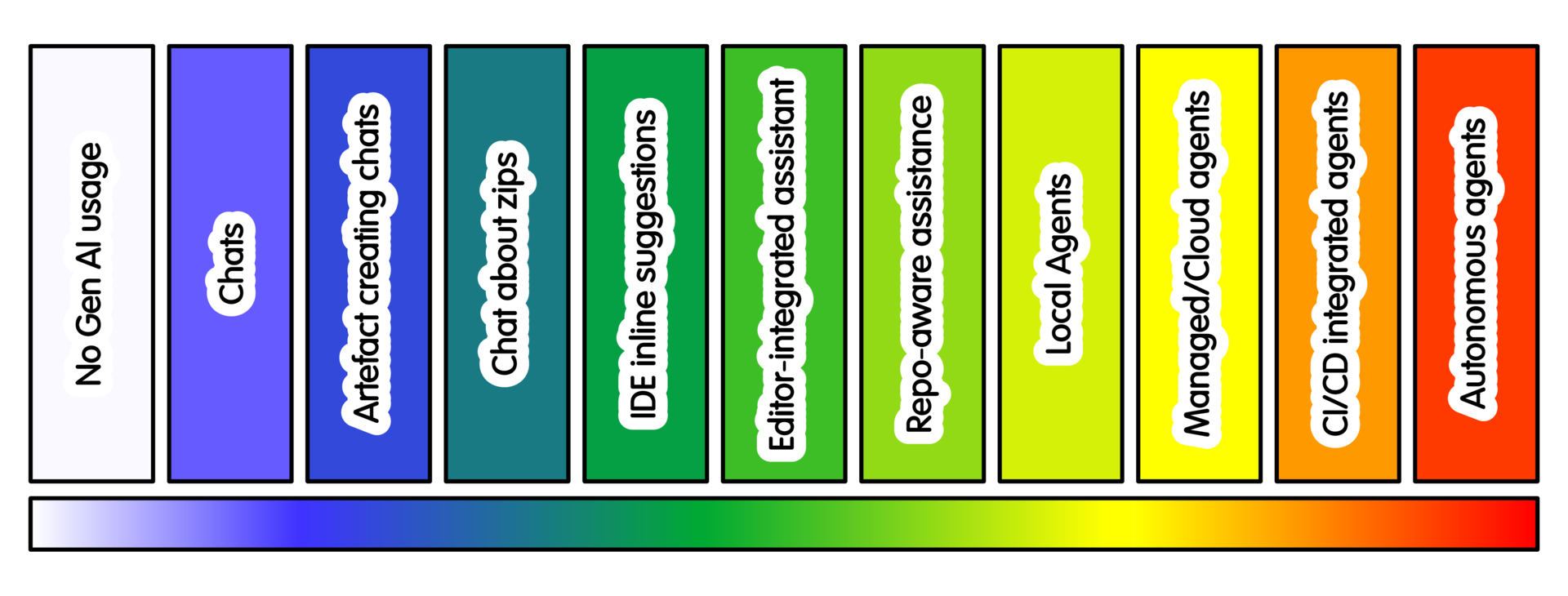
Spectrum of Intensity of AI Usage
The organising principle used in this section is a Spectrum of Intensity of AI Usage. The purpose of the spectrum is to assist in deciding what level of intensity is suitable for your work.
This correlates with how much context, authority, and autonomy a tool has. It is not a maturity scale. Higher intensity does not mean better practice. It does not mean higher skill. It does not mean better quality.
It is also worth remembering that a key part of any evaluation infrastructure for AI-assisted practice is your manual practice. AI doesn’t replace your skills - it requires your skills more than ever.
Intensity correlates with a number of other issues including:
- Level of AI use/autonomy in the workflow
- Complexity of the AI setup
- Cost, Environmental impacts
- Severity of consequences (blast radius) of failure
- Volume, complexity and novelty of output
Questions to consider of your project and of yourself:
- Where does your project sit? Where should it sit?
- Where do you sit? Where do you want to be? Where should you be?
Guidance
Guidance pages focus on overview, high level, and cross cutting concerns.
 tasks ai
How do you use AI to develop quality research software
tasks ai
Overview and comparison of tools useful at different levels of the AI spectrum
Practices
Practice pages focus on specific guidance for a given style of usage, ordered by intensity level.
tasks ai
Considerations for no GenAI usage, especially in a GenAI world
tasks ai
Chats regarding explanations, trade-offs, errors and conceptual help
tasks ai
Chat-based creation of small, reviewable outputs
tasks ai
Providing selected files, snippets, or zip files to discuss, use and improve
tasks ai
AI suggestions appear in your editor, while editing
tasks ai
The assistant can make bounded edits inside the editor
tasks ai
An agent can search and reason across the repository
tasks ai
An agent can edit files, run commands and iterate locally under supervision.
tasks ai
A hosted or managed agent working asynchronously in remote environment
tasks ai
Agents are integrated into repository workflows. Can triage bugs, review and create PRs
tasks ai
Broad tool-using systems with persistence, scheduling or external integrations
Training

Ahmad Alam
The University of Manchester

Aleksandra Nenadic
The University of Manchester / Software Sustainability Institute

Michael Sparks
The University of Manchester / Software Sustainability Institute

Shoaib Sufi
The University of Manchester / Software Sustainability Institute